

Born in Missouri, Dr. Deborah Craton grew up in Bedford, Indiana, and was in the last graduating class of the old Bedford High School. She did her undergraduate work at David Lipscomb College (now Lipscomb University) in Nashville, Tennessee, and received her M.D. degree from Indiana University Medical School in Indianapolis. After fulfilling a residency program in Gadsden, Alabama, she and her family moved back to Bedford, where she has practiced family medicine since 1984. She married John Craton, a classical music composer, in 1978, and they have been married now for 40 years. Together they have three grown sons, two daughters-in-law, several cats, and a number of grand cats.”

January 2026
Trust: My Word for the Year
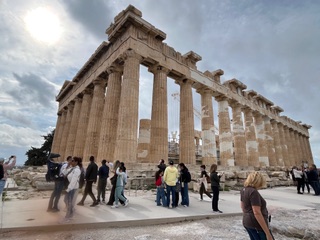
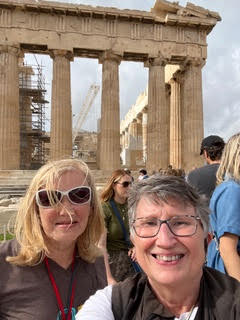
My husband and I were blessed to be able to travel this fall with our longtime friends we met when I was in medical school. We were to fly into Venice, board an ocean liner and proceed to various ports around the Adriatic Sea, down the Greek coastline and end up in Athens where our goal was to climb to the top of the Acropolis, to walk amidst the Parthenon and see Mars Hill. But, unfortunately, just a few days before the trip was to begin, we discovered that we would not be traveling with our friends. Because of the algorithm used by the company planning our trip, our friends were taking one route to and from Greece while my husband and I were traveling an entirely different route!
For most people this would not be a difficult hurdle to overcome, but in our case we were a little panicked. One of our friends has congestive heart failure and will, on occasion, have fainting spells, leaving his wife to care for him while also worrying about getting to the next destination. In our case, my husband has low vision, (as I quip on occasion, “He is blind in one eye and can’t see out of the other”) so navigating through unknown airports to get from gate to gate while transversing through customs is no easy task! When we travel with our friends we just all feel more comfortable… we are able to comfort, support and guide each other.
When my husband and I realized that we would be traveling alone, I told him, “You are going to have to trust me.”
He looked at me with a hurt expression, replying, “I trust you. I love you.”
I told him, “Loving someone and trusting someone are not necessarily synonymous.” He was puzzled. I explained: “When I say turn left, you need to turn left. When I grab your arm to stop, you need to stop. If I need to stop and ask directions, you need to let me do that. You need to trust that I am seeing things you are not, that I am doing what is best for the both of us.”
It was then he finally understand what I meant by “trusting” me. He was going to have to let me be in control. All of our marriage, he had always made the decisions. He read the maps, he followed the signs, he lead the way. On this trip, for us to have a safe and enjoyable journey, he was going to have to trust me to do those things. He was going to have to let go….
Over the last few weeks I have been struggling with trust…trust in God. Oh, I have read the verses:
Trust in the Lord with all your heart
and lean not on your own understanding;
in all your ways submit to him,
and he will make your paths straight. (Proverbs 3:5-6)
Let us hold unswervingly to the hope we profess, for he who promised is faithful. (Hebrews 10:23)
Do not let your hearts be troubled. You believe in God; believe also in me. (John 14:1)
I love God. I believe in HIM and His promises. I have read the Bible. I know the stories and know how HIS promises to the Israelites were fulfilled. I have read the Psalms and believe David when he tells us through song how he had trust in God. I know all of that and believe all of that.
I know God loves me. HE sent His only begotten Son to die for me so I might have eternal life. I know ALL of that. I believe ALL of the Scriptures. And yet, do I trust HIM?
Can I let go of tomorrow? Can I let HIM guide the way? Can I trust that HE sees the things that I can’t? Can I really trust HIM when HE says He will not give me more than I can handle? Can I truly TRUST God with all of my life…every part, every moment? Can I really let HIM have control?
2026 is my year to learn to TRUST God…in all things, in all ways.
February 2026
February is the month of “love.” I have, over the years, written several thoughts about love, but it never hurts to look at it again, especially in light of all the unrest throughout the world.
Many of my ideas about the various aspects of love are taken from C S Lewis’ Book The Four Loves. He maintains that, based on the Greek words for love used in the New Testament, there are four aspects to love. All of these have at their root….God! For, as the Apostle John tells us in his first epistle, “God is love.” (I John 4:8)
Our first understanding of love comes from our relationship with family. Unfortunately, not everyone has a positive experience to draw from, but family should, as God intended, teach us about affection for one another. We are made in God’s image and therefore are meant to love and be loved. At the birth of a child, a mother is drawn to her infant, and studies show those very first moments in a baby’s life help develop bonds that are difficult to break. Affection, as the Greeks would have said, is that close bond within a family, within a close community, and among friends. Look to Ruth and Naomi, Mary and Martha, or even Paul and Timothy to find what affection looks like. (Ps 103:13; II Timothy 1:5)
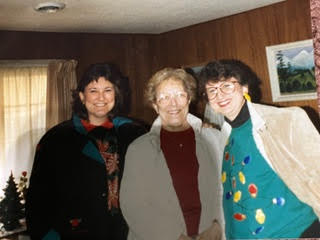
Throughout the years, I believe we can all say there have been two or three people that we can say were our “best friends.” We are indeed fortunate if there has been one person who has been with us in every stage of our lives that, as Lewis says, we discovered, “You think that way too! I thought I was the only one.” Like Jonathan to David, Elisha to Elijah, or John to Jesus, it is that person, other than a spouse, that knows us best. In English we say we love that person. In Greek, we would say we have a friendship with that person. When we part, whether by life circumstances or by death, a part of us is missing. There is no longer that iron to sharpen us, that one who makes us better, that person or persons we chose to be close to because we found we had something in common. (Proverbs 27:17; Ecclesiastes 4:9-10)
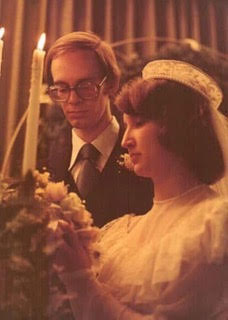
The world has taken the Greek word eros and turned it from a form of intimate love between a man and a woman into something that is only about sex. For years “to make love” was a euphemism for sex. But love between spouses is more than sex. It is about commitment, about bonds that cannot/should not be broken. In Scripture, eros is about sacrifice and faithfulness. Although Solomon understood this type of love as can be seen in the Song of Songs, he did not carry his thoughts through into his life. With 1000 women, including both wives and concubines, he just could not get it correct. God intended for one man and one woman to become one singular entity and to submit to each other. (Genesis 2:24; Ephesians 5:25)
The final type of love that C S Lewis describes is the ultimate love…the type of love Christ had for us when He died on the cross, the type of love God has for us when HE sent Christ to die for us. It is the unconditional, sacrificial type of love known as agape. It has been said that agape is the love “God commands and supplies. It is not rooted in emotion but in obedience and grace, made possible through Christ.” Through God’s example and through Christ’s example we can know what true love is! (John 3:16; I John 4:9-11; I Corinthians 13)
Notice that the first three loves—affection, friendship, eros—are all based in AGAPE. With God being love and Christ being the ultimate example (even in eros because we are to love our spouse as Christ loved the church), how much better would the world be if we exemplified the love God instilled within us when HE made us in HIS image.
March 2026
Tis the season for accolades: The Academy Awards, the Golden Globes, the Winter Olympics. They all have one thing in common. All the winners “shout out” to those who been their biggest supporters. Each winner mentions those that helped them on their journey to the award or prize they were being granted.
If you were being given an award tomorrow, who would you say was your biggest supporter? Who gave you that boost when you really needed it? Who would you be thanking for the support they gave you?
I look at my life and I see not one particular person but several. Without them I would not have succeeded as I have.
My parents were great supporters when I was younger. I don’t ever remember them telling me I couldn’t achieve something. I wanted to be an astronaut. “Write NASA and see what you need to do to be an astronaut.” I wanted to be a doctor. “Did you know that Lipscomb has a great pre-med program?” They were always looking for ways to help me achieve my goals.
My older sister was always there for me. She led the way through grade school, high school, and college. It was when I went to medical school that I realized how much I had relied on her and her support. I could also tell you if it weren’t for the long distant phone calls early in my marriage, my husband would never really have had a decent meal on the table. Her help through the years in all aspects of my life have gotten me where I am today.
I cannot begin to name friends who have supported and encouraged me through the years. I have friends that I met before I started kindergarten, those I met in kindergarten, those I met in high school, college, medical school and residency that have all been uplifting and supportive. I have colleagues I have met and formed relationships with through my years of practice that I have called on and received advice and help. And of course, I would have never made it through my office practice without the support of my wonderful staff members! There are friends from all the different churches I have attended through the years who kept me grounded in my faith.
Oh, and then of course, there is my help-meet of 48 years—my husband, John Douglas. From college, to medical school, through those long hard years of my medical practice, to being the constant in my Boys’ lives, John Douglas was always there cheering me on, encouraging me, holding me when the darkness came. And after retirement, he has continued to cheer me on. My first three books would never have made it to the shelves if not for his encouragement. My Sunday School lessons would be flat if not for his critiques. John Douglas has been and still is my biggest earthly supporter.
But who I really see as my biggest supporter is the Father—God! Who saw that I needed the parents that I had? Who knew I needed the big sister that is always there? Who made sure I surrounded myself with the friends I needed to help me at different seasons in my life? Who but God knew I needed a help-meet like the one HE placed in my path? My biggest supporter has been, is and always will be God the Father, Christ the Son through whom eternal life is possible and the Spirit who is with me everyday to keep me connected to the Father.
My biggest thanks for His support goes to God!!!
April 2026
We all have faced numerous challenges in our lives. There is the challenge of getting through school and graduating; the challenge of deciding on college, trade school, or going straight into the workforce. Some face the challenge of deciding whether to marry or not to marry. Married couples face several challenges if their union is to last “until death do you part.” They face the challenge of learning to live together, the challenge of bringing home their first child. There is the challenge of raising the children and then letting those children go. There is the challenge of learning to live together again after the kids leave home, and then there is the challenge my husband and I faced almost four years ago…retirement!
My husband had been the rock of our household the entire time I was practicing medicine. He got the boys up and off to school every morning. He paid the bills. He did the grocery shopping. He took care of everything. Then July 1, 2022, I was home… all the time. I was now able to do the laundry, clean the house, go to the grocery store. I was home every day the first six months of my retirement.
What he and I learned after those first few months is that he did things well, but there was a better way of doing those things…my way. He laughingly said several times, “I didn’t know I was doing it wrong all those years!” So, my challenge was learning that, unlike medicine in which there is usually only one right way to treat a problem, this is not so much the case in living a normal, everyday life.
When I retired, I had a list of tasks that I wanted to accomplish. After taking a few weeks just to decompress from working 38 years, I set myself to fulfilling some of those tasks. I strove to discover not only where I was needed, but I also looked for avenues that would give me a sense of personal fulfillment. I knew my husband needed me, but I also knew he could function without me. I needed something of my own.
I soon found my niche by volunteering at our local history museum and through writing. Both of these got me out of the house for a few hours each week and allowed me to spread my wings a little more. It also gave my husband back his space.
But I knew that we also had to stay connected. When I worked away from home, part of our routine was coming home and each of us talking about what we did during our time apart. When a couple spends all day together, that conversation sometimes stops. We started making sure we had tea together in the afternoons or, in the warmer weather, sitting on the porch sipping a cold drink. It gave us time to reconnect…talking about the Boys or his or my writing projects. The lines of communication stayed open, and we learned to cherish those minutes in the afternoons.
It was after I finally established my own daily routine following retirement that I was able to let go of wanting to do things “my way.” Don’t misunderstand, there are things he could do “better” but now it is easier to it let go. Does it really matter if the laundry is all done, folded, and put away before noon? Sometimes it is okay if it takes all day and the towels are folded in thirds and not halves. It is okay not to have a schedule and just let things happen.
It took, takes, and will continue to take patience, understanding, and perseverance to adjust to the challenges of the past, the present, but also those that are on the horizon. Challenges require resilience and creativity to make it.

 God-Styled Life with Maggie P